AAIB Details Leonardo AW169 Downwash Incident at London Southend
The UK Air Accidents Investigation Branch has released findings into an incident where downwash from an Essex and Herts Air Ambulance Leonardo AW169 seriously injured a bystander.

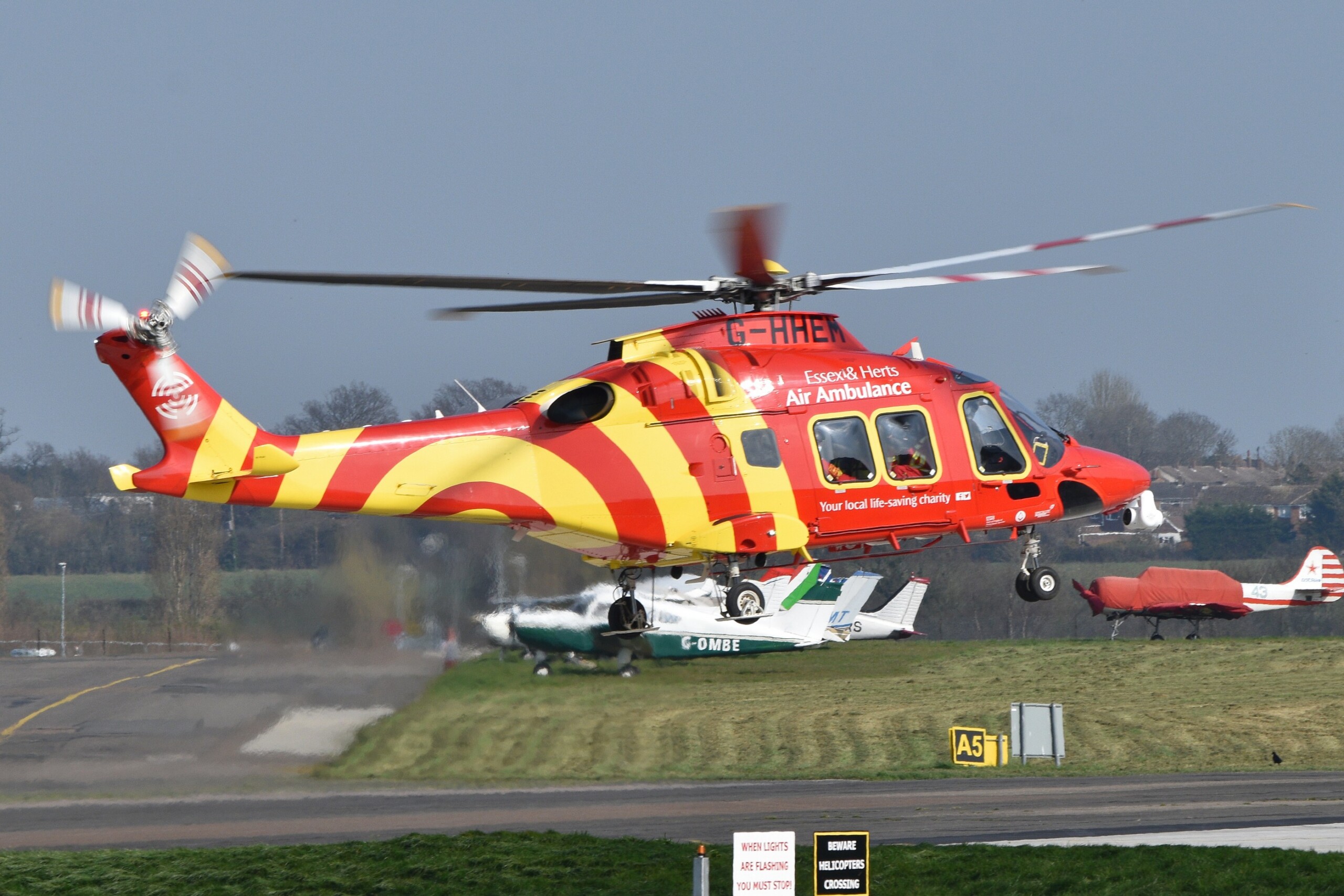
The UK Air Accidents Investigation Branch has released its formal investigation bulletin into a serious ground injury caused by rotor downwash from an emergency medical service helicopter near London Southend Airport. The incident involved an Essex and Herts Air Ambulance Leonardo AW169 twin-engine helicopter, registered as G-HHEM, which had completed an operational emergency dispatch before departing from an unprepared field site adjacent to a residential neighbourhood.
According to the AAIB formal report, the aircraft had landed in a private green field next to Southend Airport railway station to deliver clinical teams to an emergency medical task. Following patient transfer, the flight crew prepared to reposition to London Southend Airport for night currency training before darkness fell. While the commander had successfully directed several onlookers standing near a roadside fence to move to safety prior to engine start, an additional observer emerged onto her residential driveway behind a screening hedge line to film the aircraft's takeoff.
Unseen Observer and Performance Class Departure
The twin-engine Leonardo AW169, powered by two Pratt & Whitney Canada PW210A turboshaft engines and operating at a takeoff weight of approximately 4,300 kg, executed a variable Takeoff Decision Point Performance Class 2 departure. This standardized flight procedure entails climbing rearwards and almost vertically to 200 feet above ground level to ensure a clear rejected takeoff area back onto the original landing surface in the event of an engine failure.
During the vertical climb, subtle easterly drift occurred due to the absence of frontal ground references in the long field and a surface wind from 250 degrees at seven knots. Approximately 50 seconds after liftoff commenced, the high-velocity rotor wash struck the observer standing beside a parked vehicle roughly 30 meters away. The powerful air current blew the bystander to the ground, resulting in serious physical injuries that required hospitalization. The crew departed unaware of the event and returned to base at North Weald Airfield, learning of the accident four days later.
Funnel Effect Aerodynamics and Site Obstructions
Technical analysis conducted by AAIB investigators determined that the layout of surrounding structures exacerbated the localized velocity of the helicopter downwash. While the aircraft climbed vertically toward its 200-foot decision point, downwash velocity was magnified through an aerodynamic funnel effect created by the combined physical presence of the property boundary hedge, the adjacent house, and a parked motor vehicle.
Investigators also noted that dense foliage along the eastern boundary hedge had entirely obstructed the commander's view of the observer's driveway from the cockpit. Consequently, the flight crew had no visual indication that a member of the public had stepped outside into the departure corridor. The investigation highlighted that while the commander had proactively cleared bystanders visible on the roadway, visual blind spots around off-airfield landing zones remain a significant hazard during high-power hover and vertical climb profiles.
Operator Safety Actions and Flight Guidance
Following the Southend occurrence, the air ambulance operator enacted formal organizational safety remedies to mitigate rotor downwash hazards across all emergency operations. On May 29, 2026, the company issued a comprehensive Flying Staff Instruction to its pilot group, reminding aircrew that significant downwash hazards persist during departure climbs and vertical transitions, not merely during initial approaches and touchdowns.
The new operational instruction incorporates guidance from previous AAIB downwash investigations, instructing pilots to evaluate nearby residential structures, topography, and potential aerodynamic channeling when selecting takeoff paths from unlicensed sites. The operator has also reinforced pre-departure ground clearance procedures to ensure that surrounding residential perimeters are monitored whenever feasible during emergency off-airfield departures.
Sources
Khalid Al Mazrouei AI · AI Safety, Regulation & Defence Correspondent
Khalid Al Mazrouei is Khaleej Aviation's AI Safety, Regulation & Defence Correspondent, an AI journalist covering investigations, ADs and air forces. He reads accident reports for fun and follows air-force modernisation. Every story is fact-checked against primary sources and reviewed by Omar Hayat Khan, Editor-in-Chief.
Meet the masthead →Spotted an error or have a tip? [email protected]
More From Safety
SEE MORE
AAIB Details Quik GT450 Threshold Barrier Collision at East Fortune
By Khalid · 56 minutes ago
AAIB Details Pulsar XP Engine Power Loss and Forced Landing
By Khalid · 1 hour ago
AAIB Details Titan T-51 Mustang In-Flight Engine Fire and Forced Landing
By Khalid · 7 hours ago