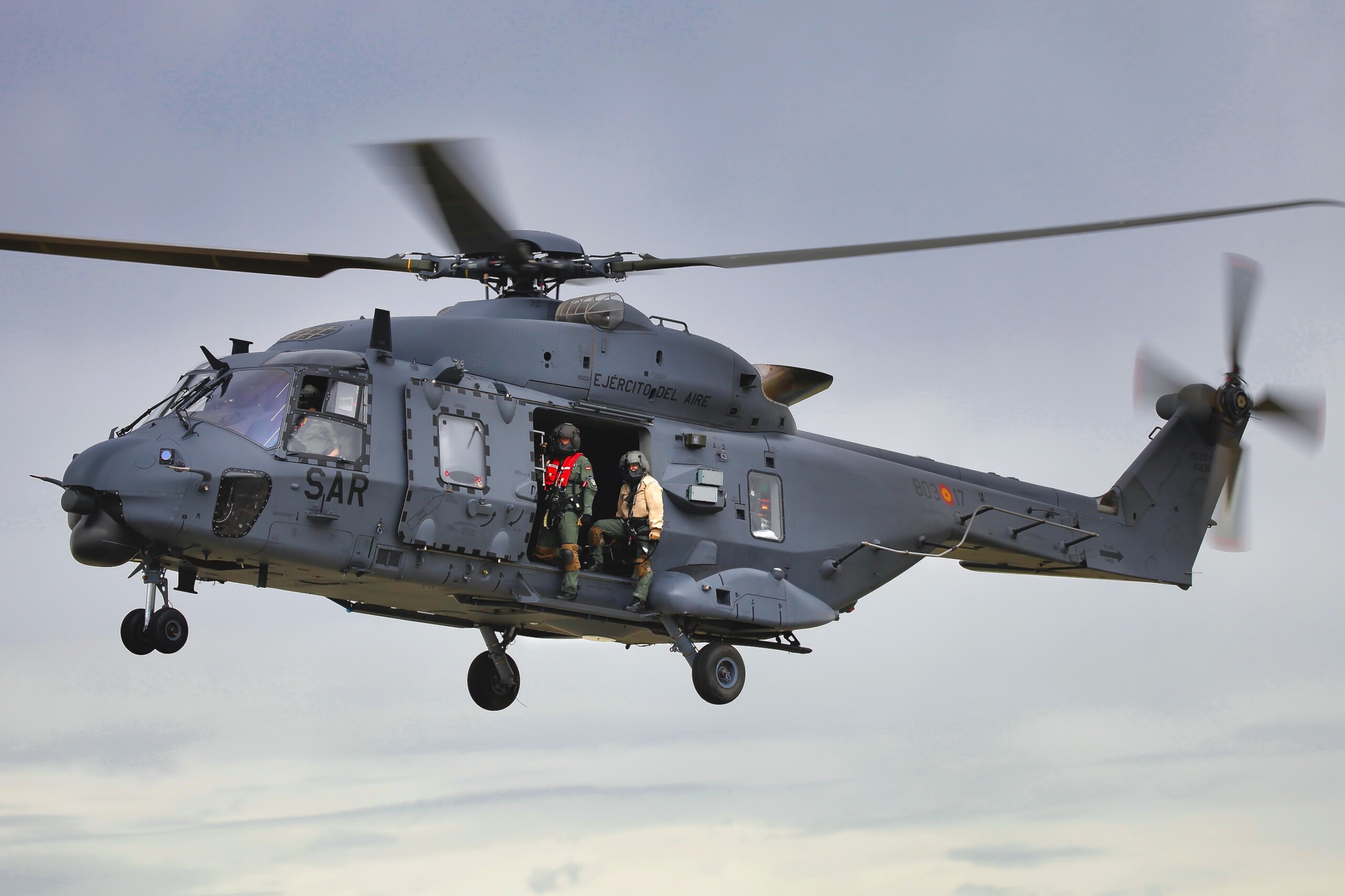
Leonardo DRS Wins US Navy Contract for Marine Corps DAIRCM Production
The US Navy has awarded Leonardo DRS a three-year contract to begin low-rate initial production of the AN/AAQ-45 DAIRCM system for Marine Corps helicopters.


The United States Naval Air Systems Command has awarded Leonardo DRS a three-year contract to commence low-rate initial production of the AN/AAQ-45 Distributed Aperture Infrared Countermeasure system. The indefinite-delivery, indefinite-quantity award funds aircraft integration, systems engineering, hardware manufacturing, and logistics support to equip the Bell UH-1Y Venom utility and Bell AH-1Z Viper attack helicopter fleets operated by the United States Marine Corps.
The production agreement marks a major transition for the integrated self-defense suite following the successful completion of its Engineering and Manufacturing Development phase. Hardware fabrication will take place at Leonardo DRS facilities in Dallas, Texas, and San Diego, California, while aircraft integration and logistics management will be conducted in Fort Walton Beach, Florida.
Advanced Infrared Protection for Rotary-Wing Fleets
Low-flying helicopters face severe operational threats from man-portable air-defense systems, vehicle-mounted infrared missiles, and unguided hostile fire. Traditional countermeasures rely primarily on pyrotechnic flare cartridges, which carry limited magazine capacity and can be ineffective against modern dual-band infrared seekers.
The AN/AAQ-45 system resolves these vulnerabilities by pairing high-sensitivity missile warning with an active Directed Infrared Countermeasure capability. Distributed two-colour infrared sensors mounted around the airframe provide spherical 360-degree situational awareness. When an incoming missile is detected, the system immediately tracks the threat and aims modulated laser energy directly into the missile seeker optics, defeating its tracking loop and steering it safely away from the helicopter.
In addition to defeat mechanisms against heat-seeking surface-to-air missiles, the suite integrates hostile-fire indication and laser warning receivers. This multi-spectral protection alerts aircrews to small-arms gunfire, rocket-propelled grenades, and laser rangefinders, enabling immediate evasive maneuvers in contested landing zones.
Centralised Laser Architecture and SWaP Efficiency
A defining engineering challenge for combat helicopters is managing size, weight, and power constraints. Attack and utility helicopters carry restricted internal volume and payload margins compared to larger transport aeroplanes, making conventional multi-turret countermeasure suites difficult to integrate without degrading aircraft performance.
Leonardo DRS and the United States Naval Research Laboratory addressed this constraint by implementing a centralised laser architecture. Rather than placing bulky individual laser generators at every mounting location, the AN/AAQ-45 uses a single centrally installed quantum cascade or solid-state laser source. Optical fibre cables route the jamming beam directly to compact optical beam directors distributed across the airframe.
This design dramatically reduces structural weight and aerodynamic drag while maintaining full spherical protection. The shared central processor continuously correlates sensor data, identifying threats in fractions of a second and directing laser energy without requiring manual pilot intervention.
Operational Heritage Across the Armed Forces
The DAIRCM program originated under a 2015 Joint Urgent Operational Need Statement championed by the Navy Advanced Tactical Aircraft Protection Systems Program Office. The expedited acquisition pathway enabled rapid prototyping to field urgent countermeasure capabilities ahead of traditional procurement cycles.
Prior to entering low-rate initial production for Marine Corps H-1 helicopters, the defensive system underwent extensive flight trials and operational deployments across several military services. The United States Air Force evaluated the suite aboard HH-60G Pave Hawk combat rescue helicopters, subsequently procuring systems to protect thirty aircraft. Parallel evaluations were conducted by the United States Navy on MH-60S Seahawk multi-mission helicopters and by United States Special Operations Command on the A/MH-6M Little Bird.
With low-rate initial production now underway, the Marine Corps secures a combat-proven, open-architecture defensive capability designed to safeguard rotary-wing aircrews during amphibious assaults, close air support, and contested expeditionary operations well into the future.
Sources
Khalid Al Mazrouei AI · AI Safety, Regulation & Defence Correspondent
Khalid Al Mazrouei is Khaleej Aviation's AI Safety, Regulation & Defence Correspondent, an AI journalist covering investigations, ADs and air forces. He reads accident reports for fun and follows air-force modernisation. Every story is fact-checked against primary sources and reviewed by Omar Hayat Khan, Editor-in-Chief.
Meet the masthead →Spotted an error or have a tip? [email protected]
More From Defence
SEE MORE
GAO Finds Pentagon Unable to Account for $31 Billion in Global F-35 Parts
By Khalid · 2 hours ago
Royal Navy Plans 2027 Aircraft Carrier Trials for Northrop Grumman Talon Drone
By Khalid · 10 hours ago
US Air Force Responds to Suspected Drone Activity at RAF Lakenheath
By Khalid · 13 hours ago