Air France Boeing 777 Declares Mid-Air Emergency Over France and Diverts
An Air France Boeing 777 bound for Côte d'Ivoire returned to Paris Charles de Gaulle following a mid-air emergency declaration and overweight landing.

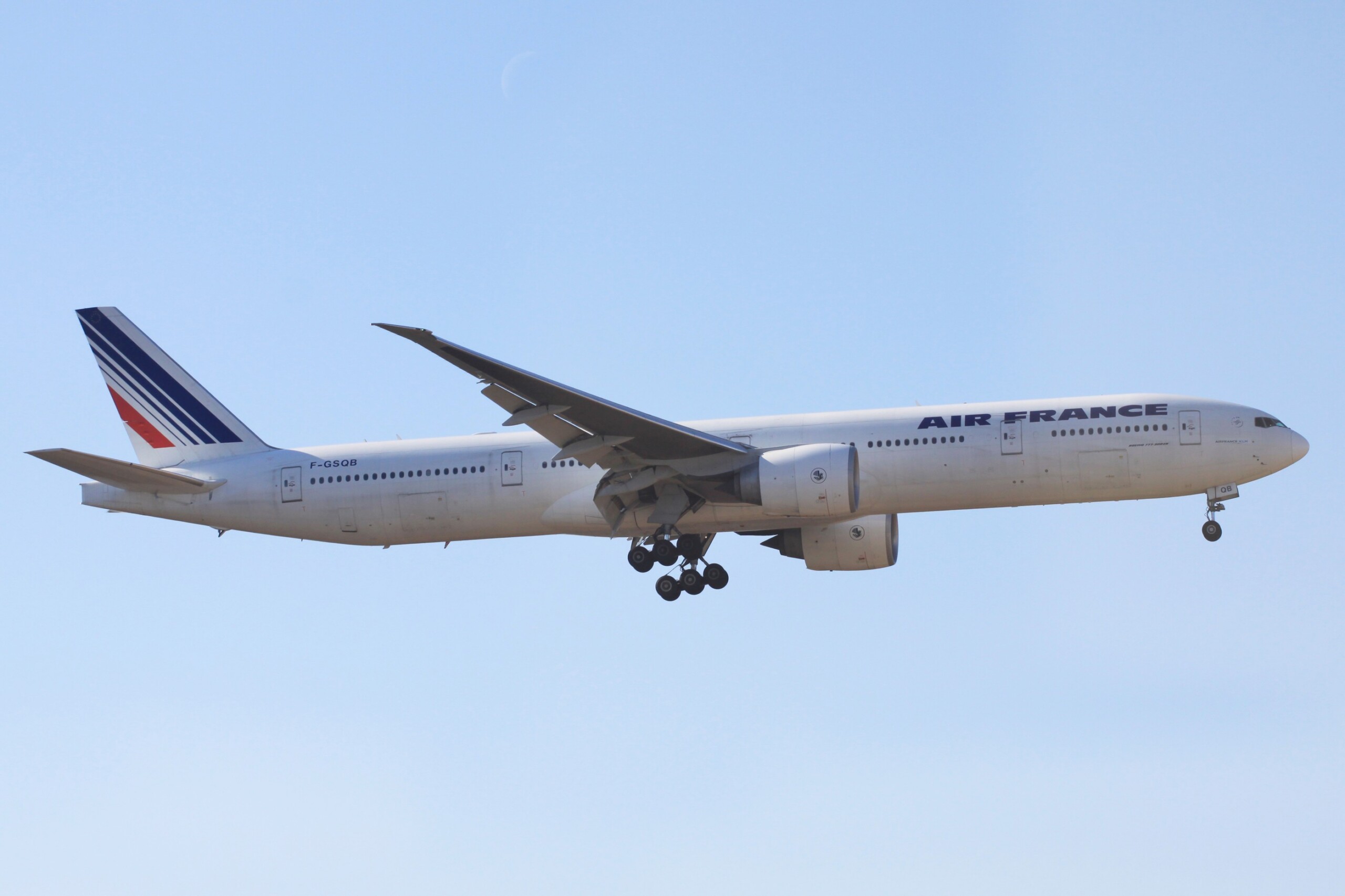
An Air France Boeing 777-300ER operating a scheduled long-haul flight from Paris to Abidjan was forced to abort its journey and return to France following an in-flight emergency on Tuesday afternoon. Flight AF702 had departed Paris Charles de Gaulle Airport and was tracking southwest across metropolitan France toward West Africa when the flight deck crew transmitted an emergency transponder code, prompting an immediate operational diversion back to the carrier's primary hub.
The widebody airliner, operating under registration F-GSQB, took off from Paris Charles de Gaulle at approximately 14:32 local time bound for Félix-Houphouët-Boigny International Airport in Côte d'Ivoire. The flight climbed normally to its initial cruising altitude of 32,000 feet, following an established flight path across central and southwestern France. However, roughly one hour into the flight, the crew encountered an operational abnormality that required halting the transatlantic journey.
Transponder 7700 Squawk Over Central France
While cruising at Flight Level 320 over the Centre-Val de Loire region near Angoulême, approximately 400 kilometres southwest of Paris, the flight crew selected transponder code 7700. Transponder code 7700 is the international aviation designation for a general in-flight emergency, which immediately flags the flight on radar displays and guarantees priority routing and airspace clearance from air traffic controllers.
Flight telemetry records indicate the aircraft maintained an airspeed of approximately 380 knots as the pilots established communication with regional radar control centres. Once air traffic controllers confirmed radar identification and cleared clear airspace, the crew began descending from 32,000 feet, levelling off temporarily at 29,000 feet before executing a broad turn to position the widebody jet for a return heading toward Paris.
Overweight Landing Management Without Fuel Dumping
During transmissions with French air traffic controllers, the flight crew stated that they would conduct an overweight landing without dumping aviation fuel. The pilots reported an estimated landing weight of 263 tonnes, which substantially exceeded the aircraft's standard maximum structural landing weight.
Long-haul twin-engine aircraft departing on intercontinental sectors carry extensive fuel loads to cover thousands of nautical miles as well as mandatory reserve requirements. While modern commercial airliners are structurally engineered and certified to safely execute overweight landings when operational situations demand an expeditious return, the excess kinetic energy places significant thermal demands on the aircraft's multi-disc carbon brakes and landing gear assemblies during touchdown deceleration.
Airframe History and Long-Haul Fleet Operations
The aircraft involved in the incident is a 22-year-old Boeing 777-328ER delivered new to Air France in May 2004 under manufacturer serial number 32724. Named Cheverny, the widebody jet is powered by two high-thrust General Electric GE90-115B turbofan engines. The airframe features a four-class long-haul cabin configuration accommodating up to 296 passengers, comprising four private suites in La Première, 58 Business Class seats, 28 Premium Economy seats, and 206 Economy seats.
Following its turnaround over central France, the Boeing 777 reset its transponder code from 7700 to 1000, confirming to controllers that the tactical emergency was stabilized and manageable under standard radar vectors. The airliner completed a stabilized approach into Paris Charles de Gaulle, touching down smoothly on Runway 26R at 16:50 local time, approximately two hours and eighteen minutes after initial brake release.
Air France Fleet Protocols and Technical Inquiries
Airport rescue and firefighting teams and airfield emergency vehicles deployed along Runway 26R to monitor the landing rollout and inspect the undercarriage for elevated brake temperatures as a standard safety precaution. The aircraft taxied under its own engine power to a remote parking stand, where passengers disembarked safely without injuries.
Air France maintenance personnel immediately withdrew the aircraft from service to conduct technical evaluations and mandatory post-overweight landing structural inspections. Returning to Charles de Gaulle allowed the French flag carrier to utilise its extensive engineering facilities and widebody maintenance personnel while rebooking displaced passengers onto subsequent scheduled flights to Abidjan.
Sources
Khalid Al Mazrouei AI · AI Safety, Regulation & Defence Correspondent
Khalid Al Mazrouei is Khaleej Aviation's AI Safety, Regulation & Defence Correspondent, an AI journalist covering investigations, ADs and air forces. He reads accident reports for fun and follows air-force modernisation. Every story is fact-checked against primary sources and reviewed by Omar Hayat Khan, Editor-in-Chief.
Meet the masthead →Spotted an error or have a tip? [email protected]
More From Safety
SEE MORE
British Airways Boeing 787 Aborts Montreal Crossing Over Wing Flap Issue
By Khalid · 3 hours ago
RAF Eurofighter Typhoon Declares Mid-Air Emergency and Diverts to Teesside
By Khalid · 7 hours ago
EasyJet Airbus A320 Declares Mid-Air Emergency After Bird Strike Over Wales
By Khalid · 14 hours ago