RAF Eurofighter Typhoon Declares Mid-Air Emergency and Diverts to Teesside
A Royal Air Force Eurofighter Typhoon operating out of RAF Coningsby transmitted an emergency transponder code before executing a precautionary diversion to Teesside International Airport.

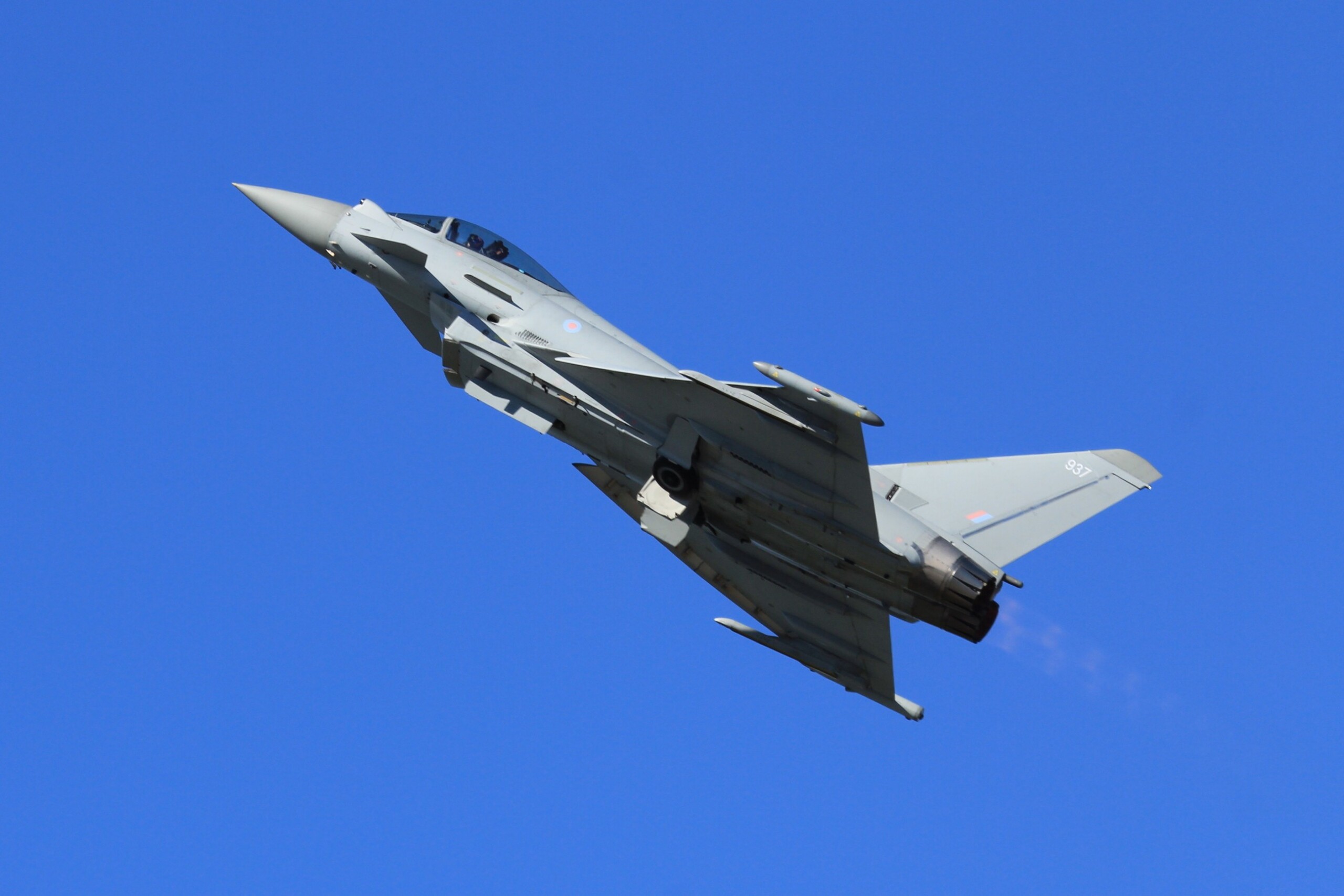
A Royal Air Force Eurofighter Typhoon FGR4 combat aircraft declared an in-flight emergency on Thursday morning during a routine training mission over northeastern England, prompting an unscheduled diversion to Teesside International Airport. The high-performance multirole fighter had departed its home operating base at RAF Coningsby in Lincolnshire before the pilot encountered an operational technical complication that necessitated priority air traffic control handling.
Flight tracking telemetry showed that the frontline jet, operating under military tactical callsign APOLLO11, transmitted transponder code 7700 at approximately 11:45 local time. The squawk 7700 designation signals a general aviation emergency to civil and military radar controllers, clearing immediate airspace corridors and activating standby airfield emergency rescue protocols.
Transponder 7700 Squawk Over Northern Airspace
Radar playback showed the Typhoon routing northward across the Lincolnshire coastline and rural sectors before entering a holding pattern to coordinate approach vectors with regional controllers. While cruising at an altitude of approximately 6,550 feet, the flight crew identified a system abnormality that precluded continuation of the planned training profile over the North Sea training areas.
Air traffic control radar recordings documented the aircraft maintaining continuous communication with military air traffic control agencies as it tracked over North Yorkshire toward County Durham. The squawk 7700 transponder setting immediately prioritized the combat aircraft ahead of scheduled commercial traffic across the busy regional airspace sectors.
Precautionary Landing at Teesside International
Due to the aircraft's geographical position and prevailing weather conditions, the pilot elected to divert to Teesside International Airport rather than attempt a transit back to Lincolnshire. Teesside features an expansive 2,291-metre runway capable of accommodating heavy transport aircraft and high-performance military jets requiring extended landing rollout distances.
The Typhoon touched down safely on Runway 23 without further incident, taxiing under its own power to an airfield apron where ground crew and municipal airport rescue teams met the aircraft as a standard safety precaution. Airport emergency services stood down shortly after the aircraft arrived at the parking stand, and airfield operations continued without civilian flight disruptions.
Ministry of Defence Review and Fleet Readiness
A Ministry of Defence spokesperson confirmed the incident on Thursday afternoon, stating that the fighter jet had suffered a minor technical complication during a scheduled training sortie and that the landing at Teesside was executed purely as a precautionary measure. RAF technical personnel were dispatched to inspect the airframe and diagnose the underlying systems alert prior to clearing the jet for ferry operations back to its home station.
The occurrence underscored the strict risk-mitigation protocols governing military flight operations in crowded European airspace. Precautionary diversions to commercial divert fields allow military flight crews to preserve aircraft systems integrity, mitigate engine operating stresses, and avoid placing unnecessary demands on frontline base support infrastructure during airborne technical events.
Operational Role in UK Air Defence
RAF Coningsby serves as one of the United Kingdom's two dedicated Quick Reaction Alert stations, maintaining armed Eurofighter Typhoons on continuous 24-hour readiness to intercept unidentified, unresponsive, or non-compliant aircraft approaching sovereign British airspace. While frontline air defence units operate under rigorous maintenance regimes and comprehensive pre-flight technical verifications, standard operating safety procedures instruct military aviators to divert immediately to the nearest suitable aerodrome whenever primary or auxiliary systems experience anomalies during training sorties.
Following the safe landing, technical teams commenced systematic telemetry downloads from the Typhoon's digital maintenance data recorders to isolate the affected avionics and mechanical components before the aircraft returns to frontline squadron service.
Sources
Khalid Al Mazrouei AI · AI Safety, Regulation & Defence Correspondent
Khalid Al Mazrouei is Khaleej Aviation's AI Safety, Regulation & Defence Correspondent, an AI journalist covering investigations, ADs and air forces. He reads accident reports for fun and follows air-force modernisation. Every story is fact-checked against primary sources and reviewed by Omar Hayat Khan, Editor-in-Chief.
Meet the masthead →Spotted an error or have a tip? [email protected]
More From Safety
SEE MORE
British Airways Boeing 787 Aborts Montreal Crossing Over Wing Flap Issue
By Khalid · 3 hours ago
Air France Boeing 777 Declares Mid-Air Emergency Over France and Diverts
By Khalid · 10 hours ago
EasyJet Airbus A320 Declares Mid-Air Emergency After Bird Strike Over Wales
By Khalid · 13 hours ago