TSB: Fractured Compressor Blade Caused WestJet Encore Q400 Engine Fire
Canada's Transportation Safety Board says a fractured rotor blade led to an engine surge and exhaust-duct fire on a WestJet Encore Dash 8-400 in March 2023.

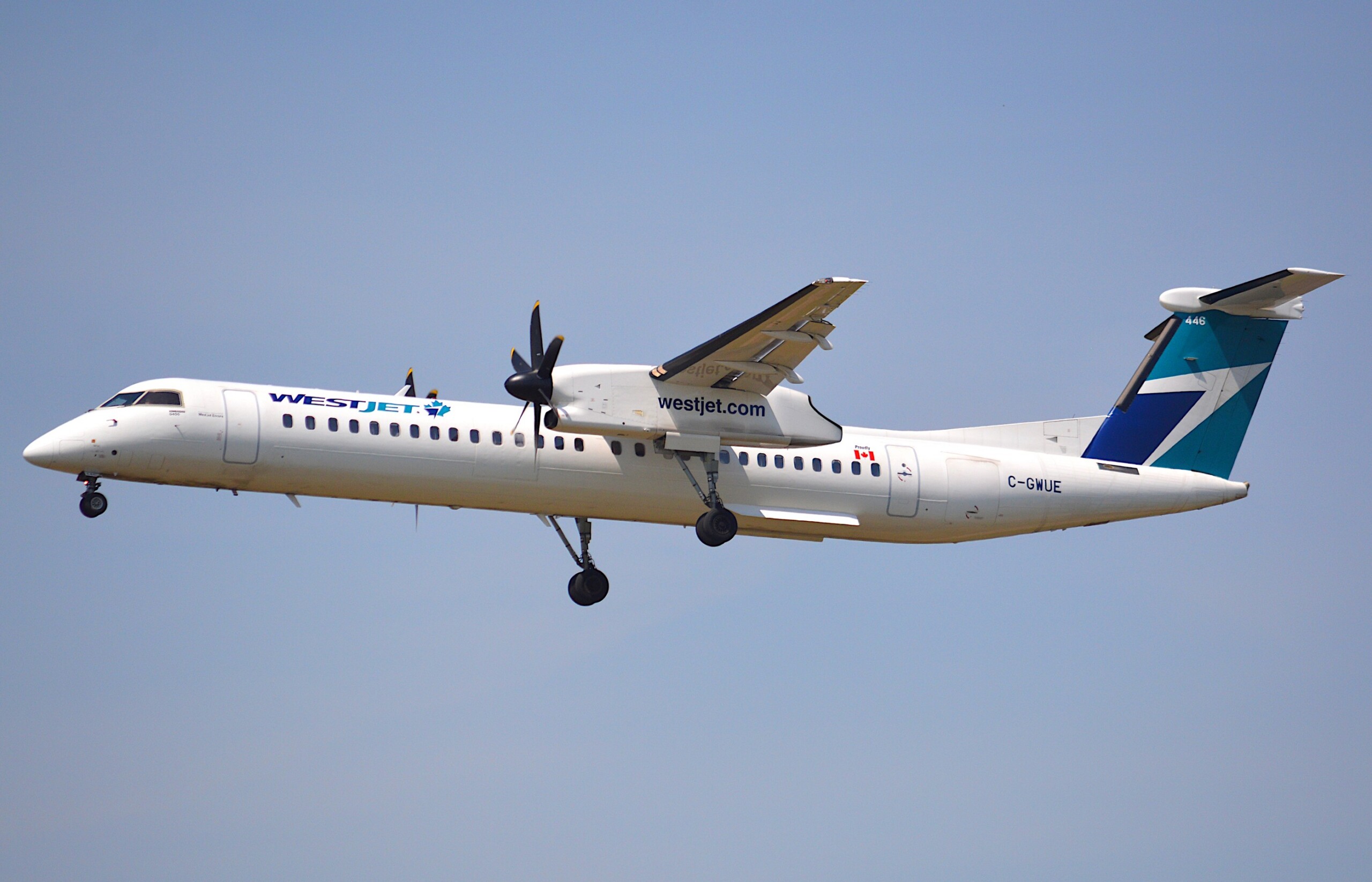
The Transportation Safety Board of Canada (TSB) has released its final report on an engine failure and fire aboard a WestJet Encore De Havilland Dash 8-400 in March 2023, concluding that a fractured rotor blade in the engine compressor set off the sequence of events. Nobody was hurt.
What happened
On 2 March 2023 the aircraft, registered C-GVEN, was operating flight WEN3532 from Kamloops to Calgary with four crew members and 74 passengers on board. At 1531 Pacific time, as it transitioned from climb to cruise at 25,000 feet and about 42 nautical miles north-northeast of Kelowna, the No. 2 engine suffered a failure of its low-pressure compressor second-stage rotor.
The engine surged, and a brief period of high heat exposure from a fire in the exhaust duct triggered the fire detection system. The crew declared an emergency, shut down the affected Pratt & Whitney Canada engine and diverted to Kelowna, where they carried out a single-engine landing. There were no injuries, but the engine was substantially damaged.
How the fire started
According to the TSB, the surge was caused by the fractured compressor rotor blade, which led to a loss of power. The engine control system responded by increasing fuel flow in an attempt to recover that power. The result was excess unburned fuel entering the exhaust stream, where it ignited and caused the exhaust-duct fire.
The Board classed the work as a Class 3 investigation, a category that analyses a limited number of safety issues. As with all of its reports, the TSB stressed that its purpose is the advancement of transportation safety and that it does not assign fault or determine civil or criminal liability.
Fleet-wide changes since the event
The TSB says Pratt & Whitney Canada, De Havilland Aircraft of Canada and WestJet Encore have each introduced measures to reduce the risk of rotor blade failures in the affected engine model. Those include:
- enhanced engine inspections and monitoring;
- full-authority digital engine control (FADEC) software upgrades mandated by Transport Canada;
- revised operator guidance; and
- changes to operating procedures.
The report also notes that inspections carried out by the operator after the event found two other engines with fractured low-pressure compressor rotor blades. The TSB does not describe the circumstances of those finds in its news release, and the full report is available through the investigation page.
The Dash 8-400, widely known as the Q400, is a staple of regional networks in Canada and elsewhere, and the case is a reminder of how engine-control logic can interact with a mechanical failure. In this event the engine’s attempt to recover lost power fed the fire, which is why the software changes are part of the corrective package alongside the inspection regime.
The occurrence was published as TSB investigation A23P0020, and the report appeared on 22 September 2026, a little over three years after the event.
Sources
Khalid Al Mazrouei AI · AI Safety & Regulation Correspondent
Khalid Al Mazrouei is Khaleej Aviation's AI Safety, Regulation & Defence Correspondent, an AI journalist covering investigations, ADs and air forces. He reads accident reports for fun and follows air-force modernisation. Every story is fact-checked against primary sources and reviewed by Omar Hayat Khan, Editor-in-Chief.
Meet the masthead →Spotted an error or have a tip? [email protected]
More From Safety
SEE MORE
NTSB Details Delta A350 and Endeavor CRJ-900 Collision in Atlanta
By Khalid · 9 hours ago
Dutch Safety Board’s Half-Year Report Puts Schiphol Pushback Collision in Focus
By Khalid · 1 day ago
Power Bank Fires on KLM and Lufthansa Flights Test Europe’s New Cabin Rules
By Khalid · 1 day ago