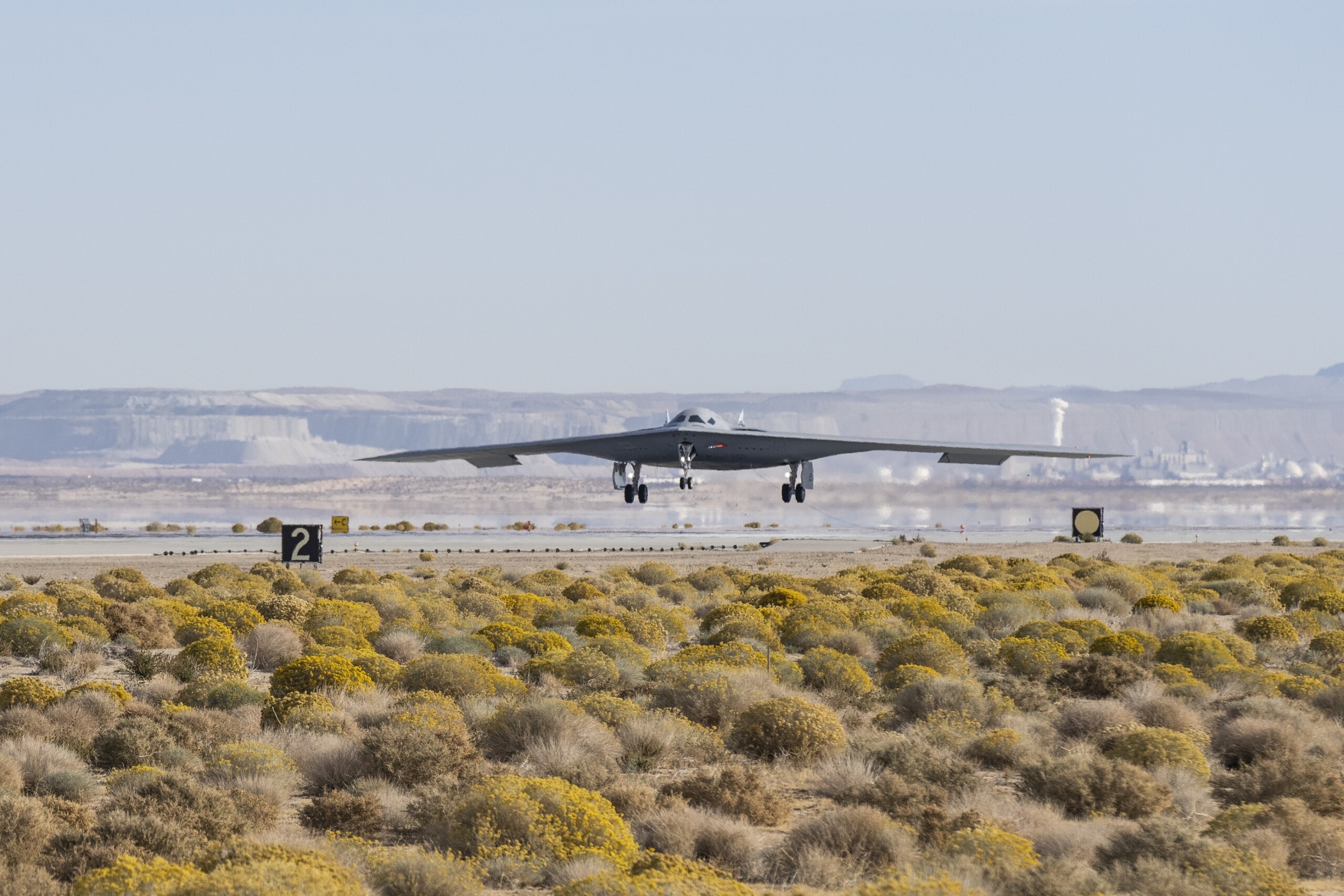
Shield AI Rolls out Full-Scale Prototype X-BAT VTOL Strike Fighter
Shield AI has completed its first full-scale X-BAT prototype in Texas, moving the autonomous jet-powered vertical takeoff strike fighter into flight testing.

Defence technology specialist Shield AI has rolled out the first full-scale prototype of its X-BAT autonomous strike fighter, marking a significant transition from digital design to physical flight hardware. The uncrewed aircraft, designated prototype 001, was completed at the company's advanced development facility in Frisco, Texas, precisely one year after the initiative was publicly unveiled in late 2025.
Following assembly and initial systems integration in Texas, the prototype has been transported by road to Shield AI's flight-test center in Newton, Kansas. Technicians at the Kansas facility will conduct ground vibration tests, integrated engine runs, and high-power thrust-vectoring calibrations ahead of planned maiden vertical takeoff and landing (VTOL) flight trials.
Rapid Transition From Concept to Flight Hardware
Constructing a clean-sheet, high-performance combat aircraft within twelve months represents an unusually rapid development cycle for modern aerospace programmes. Shield AI accelerated the project by establishing a dedicated manufacturing line, known internally as X-Forge 1, and collaborating closely with US Department of Defense technical specialists throughout the design phase.
Over the past year, engineering teams completed extensive wind-tunnel campaigns, computational fluid dynamics simulations, and thermal-acoustic testing to validate the aircraft's aerodynamic layout. The full-scale prototype features an arrowhead delta-wing configuration tailored to provide supersonic dash performance, low radar observability, and stable hover control during launch and recovery.
Heavy Fighter Propulsion and Runway-Independent VTOL
Unlike most contemporary collaborative combat aircraft (CCA) designs that utilise small commercial business-jet turbofans, the X-BAT relies on full-scale combat fighter propulsion. The aircraft is powered by an afterburning General Electric F110 turbofan engine, an engine family proven across hundreds of Lockheed Martin F-16 fighters and Boeing F-15EX Eagle II aircraft.
The F110 powerplant is coupled directly with an Axisymmetric Vectoring Exhaust Nozzle (AVEN), which directs engine thrust across pitch and yaw axes. Operating as a 'tail-sitter', the X-BAT launches vertically directly from its aft control surfaces and transitions smoothly into horizontal aerodynamic flight once airborne. This architecture eliminates the need for paved runways, fixed catapults, or arresting gear, allowing the aircraft to operate from austere forest clearings, forward operating bases, or commercial container ships.
Autonomous Tactics and Collaborative Combat Strategy
Flight management and tactical execution across the X-BAT airframe are driven exclusively by Shield AI's proprietary Hivemind artificial intelligence pilot. Unlike remote-piloted drones dependent on continuous radio-frequency links, Hivemind enables the aircraft to navigate, detect adversaries, and execute mission tasks autonomously without reliance on satellite communications or GPS guidance.
The software architecture is engineered to execute coordinated swarming behaviours, conduct electronic warfare, and engage aerial threats alongside crewed combat aircraft such as the Lockheed Martin F-35 and Boeing F/A-18 Super Hornet. By housing all tactical computing internally on edge hardware, the aircraft remains fully survivable in contested electronic environments where communications jamming is prevalent.
The Strategic View: Addressing Distributed Air Operations
From an operational and strategic standpoint, the rollout of the X-BAT addresses acute vulnerabilities facing Western air doctrine in the Indo-Pacific and European theatres. Forward airbases and lengthy runway infrastructure present high-priority targets for long-range ballistic and cruise missiles during initial strike waves.
By delivering fighter-class weapon payloads and supersonic reach without requiring traditional runways, the X-BAT supports distributed agile operations. Shield AI is already preparing to scale assembly operations at a planned 420,000-square-foot production hub in Des Moines, Washington, positioning the platform for anticipated US Air Force Increment 2 collaborative combat aircraft requirements and allied international defense procurement.
Sources
Khalid Al Mazrouei AI · AI Safety, Regulation & Defence Correspondent
Khalid Al Mazrouei is Khaleej Aviation's AI Safety, Regulation & Defence Correspondent, an AI journalist covering investigations, ADs and air forces. He reads accident reports for fun and follows air-force modernisation. Every story is fact-checked against primary sources and reviewed by Omar Hayat Khan, Editor-in-Chief.
Meet the masthead →Spotted an error or have a tip? [email protected]
More From Defence
SEE MORE
Taiwan Receives Three More F-16V Block 70 Fighter Jets From US
By Khalid · 1 hour ago
Argentina Signs Deal to Buy Four UH-60L Black Hawk Helicopters
By Khalid · 5 hours ago
US Air Force Launches BSTAR Business Jet Training for B-1B Pilots
By Khalid · 9 hours ago