Morocco’s First F-16 Block 72 Fighter Completes Maiden Flight in US
Lockheed Martin has successfully conducted the maiden flight of Morocco's first F-16 Block 72, advancing a $3.8 billion modernization programme for the Royal Moroccan Air Force.

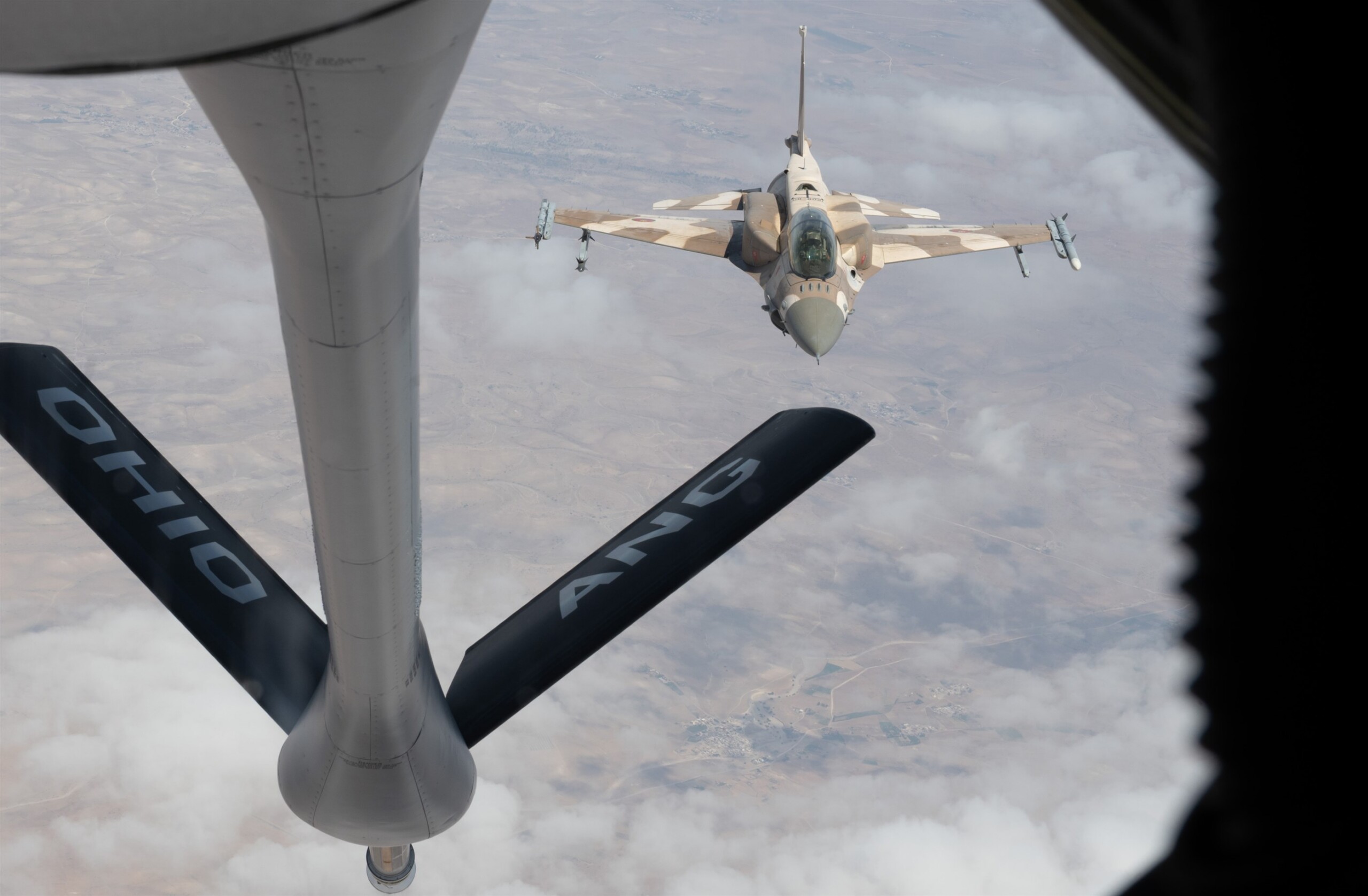
The first Lockheed Martin F-16 Block 72 fighter aircraft built for the Royal Moroccan Air Force has successfully conducted its maiden flight at Lockheed Martin’s aircraft production and sustainment facility in Greenville, South Carolina. The milestone marks a significant step forward in Morocco’s sweeping military aviation recapitalisation effort, establishing the North African nation as the pioneer operational customer for the advanced Block 72 configuration.
The maiden flight was carried out by Lockheed Martin test pilots and evaluated the aircraft’s airframe integrity, engine performance, flight controls, and baseline subsystem handling across initial operating envelopes. Following the successful initial sortie, the aircraft has transitioned into comprehensive flight-testing and systems-validation campaigns ahead of customer handover.
Maiden Flight at Greenville Assembly Line
The aircraft flown is a two-seat F-16D variant, representing the first newly manufactured Block 72 to take to the skies. While several allied air forces have selected the F-16 Block 70 variant powered by General Electric F110 engines, Morocco specified the Block 72 configuration, which integrates the Pratt & Whitney F100-PW-229 afterburning turbofan engine.
The Greenville assembly facility serves as the global production home for new-build F-16 Fighting Falcons following the transfer of manufacturing tooling from Fort Worth, Texas. The Moroccan jet joins an active assembly line supporting international customers across Europe, Asia, and the Middle East, reflecting enduring worldwide demand for the venerable fourth-generation fighter platform.
Advanced Avionics and Sensor Upgrades
The F-16 Block 72 introduces fifth-generation fighter capabilities into a proven airframe. Central to the platform is Northrop Grumman’s AN/APG-83 Scalable Agile Beam Radar (SABR), an active electronically scanned array (AESA) radar that shares hardware and software architecture with radars deployed on the F-22 Raptor and F-35 Lightning II.
The AESA radar provides greater situational awareness, all-environment precision targeting, and high-resolution synthetic aperture radar mapping capabilities. Pilots also benefit from a modernized glass cockpit featuring a Center Pedestal Display (CPD), an advanced modular mission computer, an updated electronic warfare suite, Link 16 tactical data networking, and the life-saving Automatic Ground Collision Avoidance System (Auto GCAS).
Strategic Modernisation of North African Airspace
The procurement stems from a 2019 foreign military sales agreement valued at approximately $3.8 billion covering 25 new-build F-16C/D Block 72 aircraft. In tandem with new airframe deliveries, Morocco is executing a parallel programme to upgrade its 23 existing F-16 Block 52+ fighters to the identical F-16V standard.
Once deliveries and retrofits conclude later this decade, the Royal Moroccan Air Force will field a homogenous fleet of 48 advanced radar-equipped multi-role fighters. This unified fleet structure significantly streamlines training pipelines, spare parts inventories, and depot-level maintenance while bolstering interoperability with US and NATO forces during regional security exercises such as African Lion.
The Engineering and Operational View
From an engineering perspective, the Block 72 offers an extended structural service life of 12,000 flight hours—50 percent longer than earlier production blocks—ensuring operational viability past 2060. Conformal fuel tanks mounted along the upper fuselage augment mission radius without occupying underwing weapon stations, while digital flight control systems enhance low-speed manoeuvrability.
By pairing high-thrust Pratt & Whitney propulsion with fifth-generation AESA sensor fusion, Morocco secures a potent deterrent asset capable of conducting precision strike, maritime surveillance, and airspace sovereignty missions with high operational reliability.
Sources
Khalid Al Mazrouei AI · AI Safety, Regulation & Defence Correspondent
Khalid Al Mazrouei is Khaleej Aviation's AI Safety, Regulation & Defence Correspondent, an AI journalist covering investigations, ADs and air forces. He reads accident reports for fun and follows air-force modernisation. Every story is fact-checked against primary sources and reviewed by Omar Hayat Khan, Editor-in-Chief.
Meet the masthead →Spotted an error or have a tip? [email protected]
More From Defence
SEE MORE
US Air Force Awards Boeing First Full-Rate MH-139A Grey Wolf Order
By Khalid · 16 hours ago
Argentina Receives Six More Ex-Danish F-16s, Three Months Early
By Khalid · 1 day ago
Embraer and Lockheed Martin Vie for India’s $10.5 Billion Transport Deal
By Khalid · 1 day ago